School technology is no longer a collection of separate tools. For many schools, it has become the backbone of daily operations, communication, and decision-making.
But as expectations evolve, so does the definition of what a “good” system looks like.
Modern schools are not just looking for software that performs individual tasks. They are looking for a connected digital ecosystem that supports the entire school experience.
Beyond Isolated Systems
In the past, schools often relied on multiple disconnected platforms—one system for admissions, another for academics, another for finance, and several more for communication.
While each tool may have worked well on its own, the gaps between them created friction. Data had to be re-entered. Information became inconsistent. Communication slowed down.
Today, schools expect more.
They want systems that speak to each other, share information easily, and reduce the need for manual workarounds. The goal is not simply functionality, but cohesion within a school management system.
In practice, this means a student enrolled through admissions is automatically reflected across academic records, communication lists, and billing within the same system. Schools no longer need to transfer information between platforms or maintain duplicate records manually.

A Single Source of Truth
One of the most important expectations is accuracy.
School leaders, teachers, and administrative staff all rely on data to make decisions. Parents expect information to be up to date. Students depend on clarity.
A modern school management software solution ensures that information is captured once and reflected everywhere it needs to be. Attendance, academic progress, communication, and financial data should align across the system.
When data is consistent, trust improves. When it is not, confusion spreads quickly.
For instance, when attendance is updated, that information can immediately inform parent notifications, internal reporting, and administrative tracking, without requiring separate updates in different systems.

Mobile Access as a Standard
Access is no longer tied to a desk.
Students check schedules on their phones. Parents review updates between commitments. Staff need to manage tasks throughout the day, not just during office hours.
Modern schools expect systems that are designed for this reality. Mobile access is not an added feature. It is a standard requirement in today’s education technology (EdTech) landscape. With tools like the Ed-admin Multi-Portal App (EMP), students can access timetables, parents can view attendance and reports, and staff can manage key tasks, all from a single mobile interface designed for everyday use.

Communication That Works
Communication remains one of the most visible aspects of any school system.
But volume is not the goal. Clarity is.
Schools expect communication tools that:
- Deliver the right information at the right time
- Reduce duplication across channels
- Communicate clearly without follow-up
- Support both broad announcements and targeted messaging
When communication works well, it builds confidence. When it does not, it creates unnecessary work across school administration systems.

Flexibility Without Complexity
Every school operates differently. Structures, processes, and priorities vary.
Modern systems need to accommodate this without becoming overly complex.
Flexibility should allow schools to adapt workflows, reporting, and processes to their needs, while still maintaining a clear and consistent user experience.
The challenge is balance: systems must be powerful enough to support different use cases, yet simple enough to remain usable.
Schools can adapt workflows, reporting structures, and permissions to suit their specific needs, without relying on multiple external tools or overly complex customisation.

A Connected Experience for Everyone
A school ecosystem does not serve a single user. It supports an entire community.
Students, parents, teachers, administrative staff, and leadership all interact with the system in different ways. Their needs overlap, but they are not identical.
Modern schools expect platforms that recognise this and provide tailored experiences within a unified school management platform.
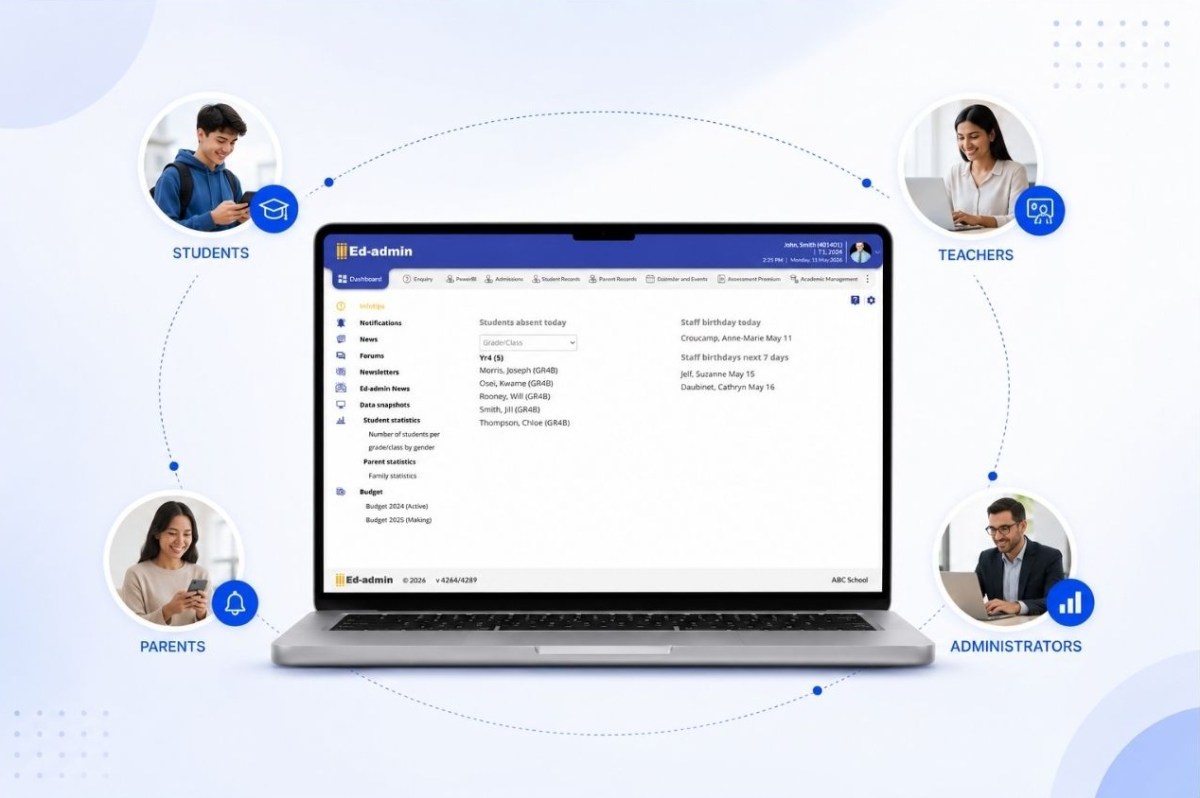
This is where integrated solutions like Ed-admin school management software become particularly valuable. By bringing multiple functions into a single platform, schools can ensure that everyone works from the same information, without losing the flexibility to meet different needs.
Within a single platform, a parent may track attendance and reports, a teacher may manage assessments and communication, and an administrator may oversee operations and reporting, all connected through the same system.

The Shift From Tools to Ecosystems
The conversation around school technology is changing.
It is no longer about selecting individual tools based on isolated features. It is about building a connected school ecosystem that supports the full rhythm of school life.
Modern schools expect systems that are:
- connected rather than fragmented
- accessible rather than restricted
- clear rather than complex
- reliable rather than reactive
This level of alignment doesn’t come from adding more tools. It comes from connecting them.
What This Looks Like in Practice
It’s one thing to describe a connected digital ecosystem. It’s another thing to see how it works in a real school day.
A student is marked absent during morning attendance.
That information is instantly available to administrators and reflected in reports.
A parent receives a clear notification through the mobile app.
Staff can reference the same information without needing to update multiple systems.
No duplication. No delay. No confusion.
This is what a connected school ecosystem looks like in practice.

Why It Matters
A well-designed school management system does more than improve efficiency. It shapes how a school operates.
When systems are aligned, processes become smoother. Communication becomes clearer. Staff spend less time managing tools and more time focusing on their roles.
For schools, the goal is not simply to adopt school management software, but to create an environment where technology supports people, rather than complicates their work.
And increasingly, it’s not a competitive advantage; it’s the standard.
Modern schools need technology that works together, not systems that create more admin and frustration.
Ed-admin helps schools streamline daily operations while improving communication and collaboration across the entire school community. Book a demo to see how Ed-admin can support your school’s unique needs and long-term growth.